Tuesday, December 14, 2010

What's in a Footprint?


Our Footprint


I talked about how 69% of all available fresh water gets used to irrigate plants, and how food travels 1300-1500 miles from farm to your plate.

You'd think these factors would make unwise food choices a big issue, when it comes to carbon footprint. I mean, all that water needs to be treated, and the vehicles transporting the food need fuel.

It turns out that if I just ate, with no thought to how far the food travels, whether it is in season or organic, and ate lots of red meat, my carbon footprint would be 1.6 metric tons per year.

It appears the maximum annual amount of carbon dioxide we can emit per individual without incurring climate change is 2.0 metric tons. So wasteful food practices consume 80% of our allowable emissions.

However, we have a much bigger issue than our food practices.

We in America emit 20.0 metric tons per individual per year.

Oops.

A family with two cars each driving the average 12,000 miles per year emits about 10 metric tons of carbon dioxide per year. The carbonfootprint.com folks put in a 1.0 ton penalty per car to account for emissions that went into making the car, amortized over the life of the car. If your two cars are Hummers, that's a whopping 16.5 metric tons per year. If your two cars are Priuses, it comes down to 6.5 - still way too high.

If you pay $200 per month for electricity, add another 2.8 tons per year.

If you're a fashion-conscious consumer, add 2.3 tons.

If you take a single round trip plane ride across the country, add 1.0 ton.

Plan to overcome your excesses by recycling? If you composted and recycled everything you use, it would only "save" 0.1 tons of carbon dioxide emissions.

Here's what my family might look like (ahem...):


Here's the picture of what contributes to the 20 tons of emissions:


And here's what the emissions look like for someone who only uses public transit, cuts electricity use by 70%, and eats/shops in an eco-conscious manner (we assume they also recycle):


It can be done.

Monday, December 13, 2010

Every herb in the season thereof...


Agricultural irrigation consumes 69% of the available fresh water worldwide.

By comparison, industry uses only 22% and households only use 8%. The remaining 1% is used for recreation and artificial environmental habitats.

The whole toilet discussion yesterday only accounts for 3% of all water use. It is significant, but pales in comparison to irrigation.

People have to eat. I agree. But what are we eating?


Approaching a Trillion tons Annual Global Food Trade)


Food Miles. The term 'food miles' refers to the distance food travels from farm to plate. Acording to the National Sustainable Agriculture Information Service (ATTRA) this distance has been steadily increasing over the last fifty years. Studies estimate that processed food in the United States now travels over 1,300 miles, and fresh produce travels over 1,500 miles, before being consumed.

We'll ignore the fact that packages of processed food either require refrigeration or are mostly air ("contents may have settled...") or are mostly water. And for the moment we'll also ignore the chemicals and "picked green" issue with fresh produce.

Eating a diet that requires lots of "food miles" is kind of nuts. Talk about a profligate waste of fossil fuel!


Water Use. Then there is the way water is used to produce crops in the world's bread baskets. California is one such place. Simple measures can be taken to reduce the current water use (or waste), such as these water conservation and irrigation improvement measures recommended by the California Department of Water Resources.

Even so, traditional soil agriculture uses 10 times as much water as aquaponics and 4 times as much energy. Aquaponics combines aquaculture (raising of fish) with hydroponics (raising plants in nutrient water). In both aquaculture and hydroponic systems, water must be replaced periodically or heavily treated. In aquaponic systems, there is no need to discard water. The fish waste nourishes the plants, which clean the water for the fish. The only necessary water use is replacement of water lost through transpiration from the leaves of the crop.


I've heard people talk about eating 100 mile diets, where they will only eat stuff they know was locally grown. With aquaponics, such a diet need not be limited to whatever crop your region grows in bulk. Nor need one subsist just on lettuce. I've seen systems where growers are raising banana and papaya trees.

I've set up my own 100 gallon system in the basement, which will have cost me less than $700 for everything, including the lights and fish. Because the footprint of the whole system is less than 3 feet by 5 feet, I call it 3x5 aquaponics. I'm not selling anything - in fact my object was to design an affordable system that anyone could put together from locally-available bits (Lowes or Home Depot, the local agricultural store (usually a mere 20 minute ride from wherever you live).

It's early days, so I'm not at a stage where I can go downstairs and harvest dinner from my own basement.

Yet.

Sunday, December 12, 2010

Water, Water, Everywhere


Installation of a Toilet Lid Sink


The world is covered with water, but less than 1% is available for drinking. The percentage is projected to shrink to less than 0.5% within a couple of decades.

What does water have to do with Peak Oil or carbon footprint? The concern is the energy required to sanitize and deliver water. And flush toilets are the single greatest user of clean water in US households.

In the 1850s folks didn't understand the link between clean water and health. Thousands of folks died crossing the plains to California due to Asian Cholera, and there are amusing reports of Queen Victoria asking why there were white papers in the Thames (they were bits of used toilet paper). Flush toilets didn't become popular in the late 19th century, and only became standard equipment in homes during the past 100 years.

We take flush toilets for granted, but they use by far the most water in domestic settings. According to DrinkTap.Org, toilets account for up to 40% of all domestic use if the toilet is leaking.

  • 26.7% Toilets
  • 21.7% Clothes Washers
  • 16.8% Showers
  • 15.7% Faucets
  • 13.7% Leaks
  • 2.2% Other Domestic Uses
  • 1.7% Baths
  • 1.4% Dishwashers

While composting toilets are an option, the >$1000 cost for flushable versions and/or the "ick" factor for the less expensive humanure-producing lovable loo make composting toilets an unlikely choice for homeowners circa 2010.

Two easy options are available:

1) Install Dual Flush plumbing. For less than $20 per toilet, you can get a unit that lets you choose normal flush (for "#2") or a reduced flush (for "#1").

2) Install a Toilet Lid Sink. For about $100 per toilet, you can put a little sink unit on top of the toilet bowl. The water to refill the toilet bowl runs through the sink - perfect for washing hands. The grey water from washing your hands then gets flushed in the next use of the toilet - long before the 24 hours when the germs in "grey water" make it scientifically disgusting.

There's another massive water and fuel saver homes can use, but it doesn't concern waste disposal. But that's for another post.

Reduce, Reuse, Recycle


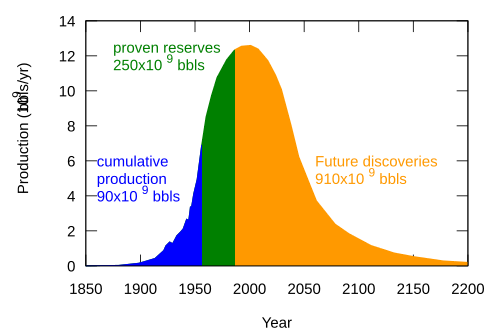
The Hubbert "Peak Oil" Plot


I've been on a detour lately, researching stuff about carbon footprint and "peak oil." Peak Oil is the idea that we're near the 50% point on fossil fuels. At the peak (which some believe has already passed) oil prices will go up, and many of the petroleum-based products we've come to rely on will become more expensive. Perhaps not rioting in the streets expensive, but at least stressful expensive.

The Good. Luckily, I have a steady job. While my employer is proposing pay freezes next year, that's a far cry from being laid off. I also own a modest townhouse near the city, along a major bus route.

The Bad. I've calculated my personal carbon footprint over at CarbonFootprint.Org. I consider carbon footprint to be an indication of my vulnerability to oil price volatility. While my footprint is lower than the national average, it's still much (much) higher than the world average, not to mention the UN recommended level.

So Now What? In the next few posts, I'm going to talk about things we're doing (or considering) to reduce our environmental impact, short of fleeing to an off-grid cabin in the hinterlands.

Thursday, November 11, 2010

A Blank Slate


A blank page can be inspiring. A blank blog page can be filled with anything (though hopefully an honest anything).

A blank house can also be inspiring. This past week I've been daydreaming about some lofts I see going up in DC - the Foundry Lofts in SouthEast DC, near National's Stadium and The Yards Park and Riverwalk Trail and the Trapeze School. Sigh.


I reluctantly woke up from the daydream when I saw prices for comparable lofts in DC. My dream of urban simplicity within walking/metro distance of everything is an expensive dream. Besides, I do have these other people in my life who aren't thrilled about uprooting themselves. One child was philosophical: "Could you please wait until I graduate from high school?"

Maybe it's a symptom of mid-life crisis. Others fall in love with someone other than their spouse, throwing away their old life in the belief that a new partner will magically give them what they fail to "get" with the partner and life they chose in youth. Me, I'm seduced by the idea that a new home would stay as pristine and elegant as the marketing glossies.

Yeah, right.

Back to my boxes. The good thing is that I've filled up the box shelf, and we've started in on scanning the contents of book boxes.

I have grand plans for the weekend and will report back when it is over!

Thursday, October 28, 2010

Triaging random stuff


There are days when stuff piles up.

In past, stuff on the table would get swept off into grocery bags and stashed, usually in preparation for guests. We weren't like artist Andy Warhol, who swept the ephemera of his life into 610 boxes as an artistic gesture.

No. We just didn't want to deal with our stuff. [Doesn't that sound like a statement one might make about an entire generation or country, and how that large group has dealt with the world?]

Anyway, I had a friend who had once worked as a professional organizer. She used to work for Don Aslett, author of Clutter's Last Stand.

My friend taught me the triage technique they would use to sort through stuff.

1) Separate the items on the table into three piles: keepers, trash, and "Don't know."

2) Throw away the trash. Put away the keepers.

3) Sort the "Don't know" pile into three piles: keepers, trash, and "Don't know."

4) Throw away the trash. Put away the keepers.

5) Sort the "Don't know" pile into two piles: keepers, trash.

6) Throw away the trash. Put away the keepers.

That was it.

You may modify as you wish to add recycle and/or donate boxes to contain those items you want to move out "responsibly," but the basic method is the same.

Here's my table part way through triage: A bin of my stuff to be put away, a jar of pens and stuff to be put away, a pile of papers to go through (scanner on and recycle/shred bins handy), and a small pile of my husband's game-related items he needs for an ongoing auction.

All we need to do is invite some guests over, to make sure we finish the process...

Letting go (and making money)


My beloved has performed a major purge of his games. I was surprised, if gratified, at the number of games he was willing to let go.

Many games went free to charity and local friends. A few games even got trashed (gasp).

We were left with a large pile of games (164 to be exact) that he would only bequeath to fellow gamers. Thirty-four games were donated to a local game club that maintains a library.

And the remaining 130 games are being offered for auction at Board Game Geek.

Before the auction ends on 31 October, go to boardgamegeek.com and check out what Santa was giving folks for Christmas this year...

If nothing else, it's an education in what people are willing to pay for the stuff we're willing to let go.